
By Santiago Caetano
From Madrid, Spain.
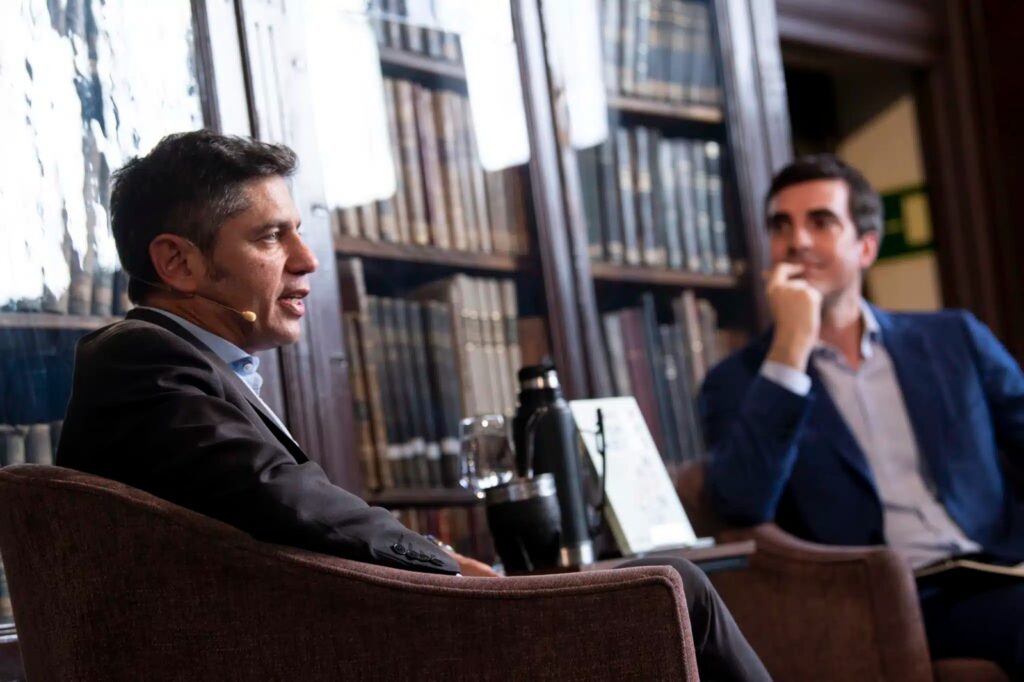
Last Thursday, the Ateneo de Madrid hosted the presentation of a new edition of From Smith to Keynes: Seven Lessons in the History of Economic Thought, written by the economist and current governor of the province of Buenos Aires, Axel Kicillof. Although the event was attended mostly by groups from the Argentine diaspora — particularly those organized through Peronist activist networks such as Argentina Soberana and Argentinos para la Victoria — there were also attendees from other backgrounds. What brought them together was the chance to listen to one of the most charismatic figures of Argentine progressivism, whose name is being mentioned with increasing force as a possible contender against the ruling party in next year’s presidential elections.
The book presentation was not merely an academic event or an editorial ceremony. Above all, it was a political intervention into the times we are living through. Kicillof used the occasion to question the conventional training of economists, denounce the crisis of the neoliberal consensus, and place back at the center of the debate the role the State should play in a period marked by the return of protectionism, geopolitical rivalry, and the exhaustion of the liberal order that emerged after the Cold War.
“Economics is studied through textbooks,” he said, offering a deeper critique of the way much of the profession is trained. According to him, this feature says a great deal about how economists think, whom they represent, what policies they recommend, and which side they ultimately stand on. What is most striking, he stressed, is that someone can graduate in Economics without having read Smith, Ricardo, Marx, or Keynes directly. Far from being anecdotal, this void reflects a form of teaching that, for decades, sought to present neoliberalism as a technical, neutral, and indisputable truth.
At that point, he recalled the years of convertibility in Argentina, when Domingo Cavallo justified economic opening, industrial destruction, and privatizations as if there were no rational alternative. That ideological climate, he argued, was shaped by the arrogant certainty of those who saw themselves as bearers of a single truth: the truth of the Washington Consensus. Today, however, that theoretical and political edifice is showing cracks everywhere.
Kicillof insisted that the current crisis of neoliberalism does not come only from its historical critics or from the peripheries damaged by its prescriptions. What makes the present moment especially revealing is that the very heart of the system has begun to dynamite its old dogmas. “The one destroying that consensus today is the United States,” he said, referring to the tariff-driven and protectionist turn promoted by Donald Trump. What until recently was denounced as economic heresy is now reappearing from the center of world power as an instrument of concrete policy.
From there, the governor of Buenos Aires defended the relevance of the history of economic thought as a tool for reading the present. Not as a museum of dead ideas, but as a living terrain of dispute among schools, traditions, and diagnoses that are once again clashing today. In his view, the problem is that reality is now accelerating at such speed that many decisions are being made before there is a theoretical framework capable of justifying them. By way of example, he recalled that it is often said that the New Deal was inspired by Keynes, even though that program began in 1933 and The General Theory was not published until 1936.
Returning to the classics, then, would not be a nostalgic gesture but an intellectual necessity. For Kicillof, the great authors allow us to recover the lesson that every theory is anchored in a historical conjuncture. Each author addresses the problems of his time, intervenes in concrete debates, and develops concepts shaped by the conflicts of his era. That historicity, he argued, dismantles the fantasy of a pure, exact, and depoliticized economics.
The present moment also seems to confirm the return of these fundamental questions. Tariffs, industrial policy, currency, value, wages, profit, among others, are old issues that are once again at the center of the scene amid the global geopolitical reconfiguration. The point is no longer only to discuss how certain variables are determined, but to ask again what they are, what social relations they are embedded in, and what conflicts they express.
Within that framework, the State reappeared as one of the strongest axes of the presentation. Kicillof rejected the idea that the market and the State are separate spheres or natural enemies, describing the promise of capitalism without the State as an “enormous fraud.” In Argentina’s recent experience, while libertarian discourse promises to destroy the State, that very State is the one guaranteeing the profitability of financial business, deregulating in favor of certain sectors, and sustaining privileges for specific interests.
From this perspective, the anti-State preaching of the far right appears less as a doctrinal novelty than as an ideological operation. Kicillof argued that, outside “marginal and bizarre” expressions, there is no serious consensus anywhere in the world proposing the liquidation of the State. The real discussion, he said, is about what kind of State is needed, what instruments it should use to intervene, and how it can be placed at the service of the majorities in a period of global transformation.
This debate takes on particular significance in Latin America. In a region marked by a late and subordinate insertion into the world market, recovering traditions such as Dependency Theory is not an intellectual whim, but a starting point for rethinking the structural problems of the present. In that regard, Kicillof referred to the Latin American situation, the crisis of the international architecture that emerged from Bretton Woods, and the growing uncertainty over the kind of world order now taking shape.
“There is a world that has ended,” he summarized. What is being dismantled is the unipolar U.S. hegemony consolidated after the fall of the Berlin Wall, while the emerging multipolar world has not yet fully taken shape. What does seem evident, he suggested, is that the United States appears willing to disregard the rules it once imposed when those same rules no longer guarantee its undisputed primacy.
Hence the political urgency of the present. “If a society does not plan, it ends up becoming part of someone else’s plan,” he warned. When a country loses the instruments to think, project, and decide independently, it also loses the capacity to assess where it is being pushed. At this crossroads, neither nostalgia for the old order nor the repetition of exhausted recipes offers a way out.
From its historical position on the periphery, “Latin America has already heard too many promises of development, wealth, and well-being that ended in deindustrialization, exclusion, and social deterioration,” he asserted. In a world scenario that remains open, the challenge is not to cling to theoretical models from other times, but to take them as reference points for producing new ideas, new tools, and, above all, nurturing a renewed geopolitical reflection from a regional perspective — so that, as Alberto Methol Ferré once put it, Latin America may cease to be merely the chorus of history.




 English
  Spanish
  Portuguese