
By Santiago Caetano
From Madrid, Spain.
The first two decades of the twenty-first century have been marked by various geoeconomic and geopolitical tensions. These have not only accentuated, as Serbin (2019) argues, a shift in the axis of global economic dynamism from the Atlantic to the Pacific, but also the decline of the international order that emerged after the Second World War. The outbreak of the conflict in Ukraine; the war in the Middle East, with the humanitarian crisis in Gaza and the confrontation between Israel and Iran; as well as the escalation of tensions between China and the United States, are all signs of a world order in crisis, moving from unipolarity toward multipolarity. These developments have created an uncertain scenario in global politics, while also accelerating geopolitical and geoeconomic processes within the framework of tensions between the West and China, granting growing significance to the configuration of global value chains.
Added to this is a key disruptive factor, the impact of the Covid-19 pandemic, which intensified trends of fragmentation and rivalry between China and Russia, on the one hand, and the United States and the European Union, on the other. In this context, the pandemic had dramatic effects on global supply chains, with a scale and speed whose most significant consequences, both in health and economic terms, were borne by emerging economies (Raj, A. et al., 2022). In this regard, Latin America, which went through the global health crisis in a context of regional disintegration and strong political polarization, was the region most affected by a crisis that sharply reduced economic growth and intensified poverty (World Bank, 2022). Considering that global transformations have negatively affected multilateral schemes of international cooperation, as well as regional integration processes in different parts of the world, the pandemic found Latin America in a moment of weakness (Bianculli, 2021). In this regard, it is important to highlight the disintegration of key regional organizations such as UNASUR, particularly the dissolution of the South American Health Council in 2018, only a few years before the outbreak of the health crisis. As Herrero and Lombardi Bouza (2023) argue, the absence of that body gave rise to disparities and antagonisms regarding the measures adopted by regional governments.
As González Levaggi (2022) argues, the acceleration of geopolitical trends brought about by the pandemic, in terms of greater competition among the major powers, generated a regression of multilateralism as well as of interest in international cooperation more broadly. In this scenario, the so-called “mask diplomacy”, through which China donated medical equipment and vaccines, and provided teams of medical experts to more than 150 countries around the world, positioned the Asian giant as the leading partner in mitigating the adverse effects of the health crisis, occupying spaces of influence at a time of U.S. retrenchment. Nevertheless, some scholars have described Chinese aid in this context as controversial, warning that through it the country was strengthening its geopolitical influence in the Global South and within global governance systems (Li and Musiitwa, 2020).
At the systemic level, as Schulz (2022) points out, the world today is experiencing a context of global chaos, within which the interrelation of multiple crises can be observed. These crises involve not only economic, commercial, technological, and ecological dimensions, but also political, social, and cultural ones. As a result, conflicts and geopolitical realignments have intensified in recent years. In this framework, while the liberal international imaginary shaped by free trade and globalization sustained by Western hegemony is increasingly receding into the past, the voices calling for decoupling from China, in the context of the geopolitical struggle between that country and the United States, show that trade relations and economic cooperation are increasingly traversed by issues related to defense and strategic security.
In this context, considering the changes in models of globalization, it is worth noting the transition from the Western model of offshoring — the relocation of production abroad — toward another model characterized by the primacy of nearshoring — geographical proximity — and friendshoring — political convergence. By way of example, this is particularly visible in the European Union’s trade strategies linked to critical raw materials, which are key to the bloc’s productive objectives associated with the Energy and Digital Transition (Pelfini and Caetano, 2024). From this perspective, value chains are redirected toward “trusted countries” in order to secure access to markets and reduce the risks associated with political discretion in countries hostile to Western interests. These processes, together with the uncertainty marked by systemic transition, reveal that global trade relations are increasingly shaped by geopolitical alignments, while also signaling a break with the imaginary of neoliberal globalization. At the same time, this has effects at the multilateral level, since the aforementioned geopolitical tensions and friendshoring strategies, as a new trend in global trade, place pressure on the system sustained by the World Trade Organization, from which these tendencies are criticized as a “new protectionist wave” (Maihold, 2022).
For their part, the social costs of globalization processes add to the unresolved consequences of the 2008 crisis of financial capitalism and to the implications of a scientific and technological revolution that accelerates historical time and makes global interactions more complex in an increasingly heterogeneous world. In this sense, the connection between these dynamics and the relative loss of power of the U.S. economy — due to the crisis of its industrial complex and the consequent loss of jobs — paved the way for anti-globalist and nationalist reactions within the Anglo-Saxon centers of power, such as Brexit in Great Britain in 2019 and the rise to power of Donald Trump in the United States, who has been critical of the multilateral organizations that institutionalized U.S. leadership after 1945.
As Merino (2020) explains, Trump’s emergence on the U.S. political scene represents the twilight of transnational globalism, within the framework of a power struggle between Americanists and globalists, whose fundamental turning point can be found in the 2008 crisis. This internal struggle reflects the projection of a unilateral and nationalist geostrategic perspective, supported by conservative sectors of the U.S. establishment and reflected in fractions of multinational capital known as continentalists, which are sustained by the U.S. nation-state (Merino, 2020; Schulz, 2022). In this sense, this dispute of interests between a transnationalized elite and continentalist fractions is symptomatic of the relative loss of power of the United States and the rest of the Western economies in the global economy, which, in turn, would reflect the end of a historical process of Western hegemony (Merino, 2020).
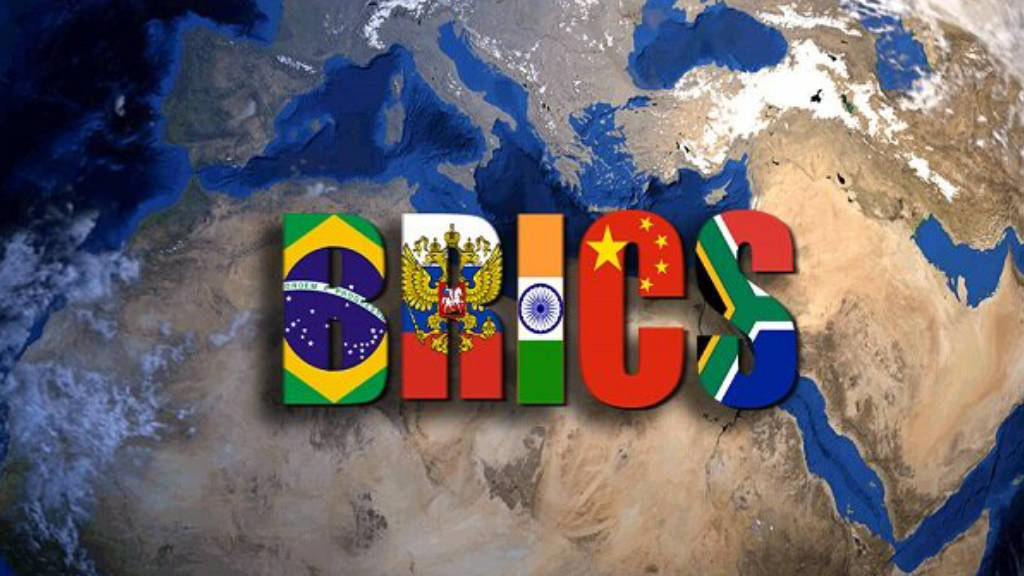
In this complex context, the creation of a new BRICS payment system stands out as a vision that seeks to materialize the transition of this group of emerging powers toward a payment system that does not rely on the U.S. dollar. This initiative aims to move away from the SWIFT banking messaging system, which is controlled by the United States. Within this framework, an effort is being made to create a payment system known as BRICS Pay, based on blockchain technology. This independent payment messaging system, promoted mainly by China and Russia, seeks to allow BRICS countries to trade in their own currencies, thereby achieving greater independence, payment capacity, and stability in the face of external pressures, particularly those related to U.S. and European sanctions.
In a context in which the dollar is increasingly used by the United States as an instrument of sanctions, and amid uncertainty shaped by the enormous increase in U.S. public debt, countries of the Global South are increasingly turning toward the BRICS in order to expand their room for maneuver and avoid Western pressure on their economies.
For this reason, initiatives such as BRICS Pay could offer greater autonomy to countries of the South within the global financial system. Faced with Western economic pressures on developing countries, particularly through the International Monetary Fund and other institutions, the emerging world, led by the BRICS, appears to be offering innovative alternatives to an international financial system in crisis, whose institutions no longer reflect the current distribution of power in the international system.
Therefore, the relative loss of Western power has given rise to a greater role for emerging powers in the global economy. This is evident in the cooperation initiatives promoted by the BRICS group, as well as in the potential these tools reveal for channeling South-South cooperation processes capable of offering real alternatives in a world marked by conflict and uncertainty.

















 Portuguese
  Spanish
  English